

Emerging importance of the Pak-Afghan belt
The emergence of the Kabul Emirate in 2021 has again created a situation where the Af-ghan regime was being cultivated by China and Russia
Emerging importance of the Pak-Afghan belt
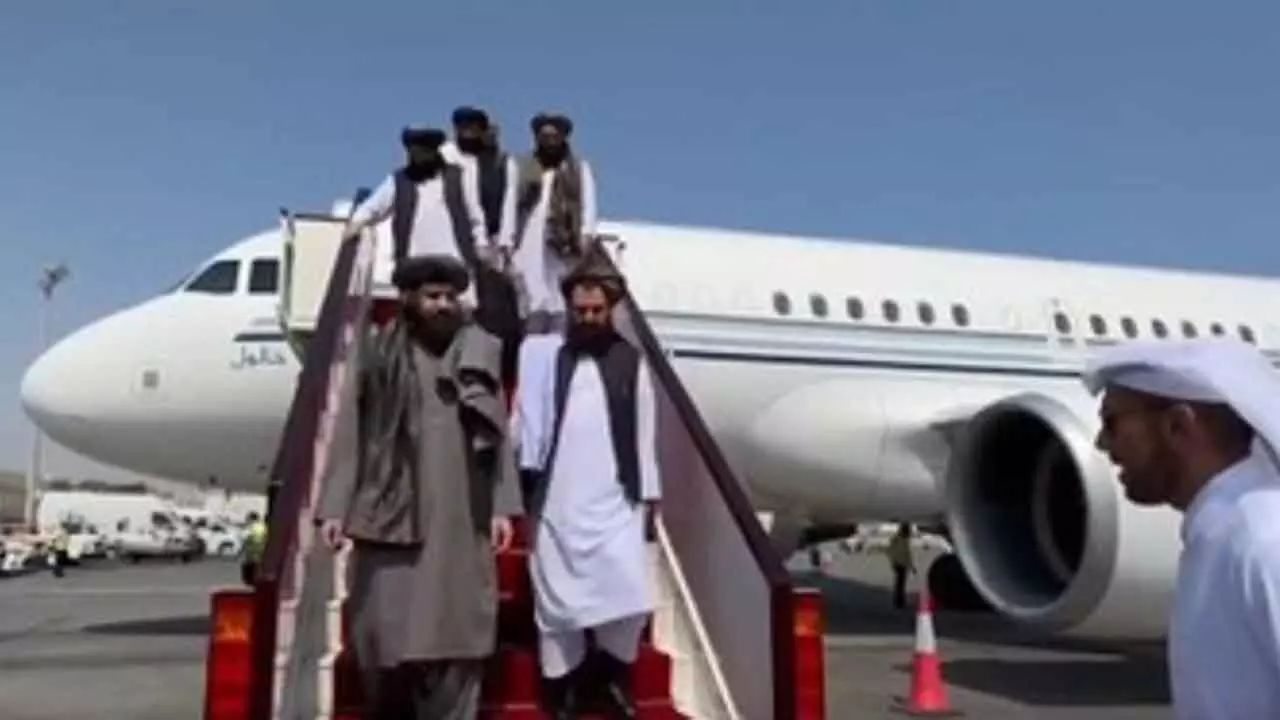
Afghanistan had the distinction of having compelled the Army of the two Superpowers, first the Soviet Union and then the US, to withdraw from its territory, and in both cases, this was achieved through an "asymmetric war" of attrition
Afghanistan, once again living up to that reputation as signs of the return of the Cold War could be seen on the Afghan horizon.
In the rivalry between the British and Russian empires in the 19th century, called the 'Great Game', Afghanistan was the key to Central Asia, and was eventually looked upon as a buffer between the two competing powers.
The emergence of the Kabul Emirate in 2021 has again created a situation where the Afghan regime was being cultivated by China and Russia, while US President Donald Trump had sought Pakistan's collaboration in establishing a deep-water American Naval Base at the Port of Pasni on the Arabian Sea.
The US move is meant to counter the impact of Gwadar Port on the coast of Baluchistan near the Persian Gulf, which had come up as an extension of the Chinese-managed China-Pakistan Economic Corridor (CPEC). India has to watch out for developments in the Pakistan-Afghanistan region, which was a breeding ground of Jehad- based violence primarily exploited by Pakistan for cross-border terrorism against India. The manoeuvrings of Pakistan to remain in the good books of the US, China and Russia - all at the same time - also deserved to be taken note of.
The recent political history of Afghanistan will help to clarify what India could or could not expect from this country of a checkered past.
Afghanistan had the distinction of having compelled the Army of the two Superpowers, first the Soviet Union and then the US, to withdraw from its territory, and in both cases, this was achieved through an "asymmetric war" of attrition.
Following the Soviet occupation of Afghanistan in 1979, the militant opposition to the invasion was first internal -coming from the Islamic terror groups controlled by Pakistan, ISI, primarily Hizbul Mujahideen (HuM), the storm troopers of the Jamaat-e-Islami, Pakistan - but was soon joined in by MI6 and CIA as Pakistan was known to be an ally of the US-led West.
The anti-Soviet armed campaign in Afghanistan was run on the war cry of Jehad and was fully supported by the US.
However, the internal resistance could not wear down Soviet troops effectively enough, compelling Benazir Bhutto, Prime Minister of Pakistan, to send the Taliban to Afghanistan in 1993 to clear the mess there.
Taliban were a "radical" Islamic force comprising the products of Deobandi Madrasas in Pakistan that followed the extremist form of Islam and carried the legacy of the Wahhabi "revolt" of the 19th century against the British encroachment on 'Muslim lands'.
At the recent Moscow Format Consultants meeting held in the Russian capital on October 7, which was attended by both India and Pakistan and where Afghanistan was present as a member for the first time, the idea of any foreign military presence in Afghanistan was firmly opposed.
The US, under President Trump, is trying to reestablish its presence in Afghanistan, particularly in the wake of the developments in the Middle East, where the military confrontation between Iran and Israel led to China and Russia taking sides with Iran because of their political opposition to the US and Iran moving to take Hamas in its embrace, adding to the threat to Israel.
Shia fundamentalism is opposed to Western Capitalism, and Hamas, a Sunni radical Islamic force, also considers the US as its prime enemy.
The turbulent Middle East was already pushing geopolitics towards a new Cold War, and President Trump-keen to project himself as the "peacemaker of the world" - had initiated a plan to bring about a ceasefire between Hamas and Israel as a prelude to peace negotiations between the two.
Trump had already claimed repeatedly that he had got the ceasefire enforced after a military confrontation broke out between India and Pakistan - both nuclear states - following the terror attack at Pahalgam.
India cannot relax its vigil against Pakistan, which was playing a clever game between the US and China to keep up its terror offensive against India. India's strategy of seeking bilateral friendships with all for preserving its security and economic interests-without aligning with any world power, seemed to be working well.
India is a major power by itself, and it has justification for treating the world as a multipolar order and pursuing the path of peace and humanity on a note of strategic autonomy.
India has identified the hostile Sino-Pak alliance as something that came right on top of its national security agenda, particularly after seeing the military collaboration of China with Pakistan in the Indo-Pak confrontation that followed Pahalgam.
India should be prepared to deal with any coordinated attempt from these two hostile neighbours to launch an offensive in future as well. India has to step up its diplomatic and geopolitical moves to counter these adversaries on the border at a time when they were engaged in fostering an anti-India environment in the countries around India.
The strategy of remaining active in both BRICS and Quad and supporting Moscow Formation Consultations serves this objective in the long term.
The outreach to the Taliban government, resulting in the first visit to India by its Foreign Minister Amir Khan Muttaqi on October 10, is also in line with the Indian strategy of denying Pakistan a hold in Afghanistan. Muttaqi was treated with full diplomatic honours even though India had not given "recognition" to the Taliban regime as yet, and External Affairs Minister S. Jaishankar held talks with him.
The visiting dignitary reiterated that the Afghan soil would not be allowed to be used for any militant activity against another country- this would act as a check on Pakistan's game of inducting Islamic radicals in the cross-border terror operations against India. India upholds the sovereignty of Afghanistan against Pakistan's violations of the Pak-Afghan border.
Muttaqi made the anticipated visit to Darul Uloom, Deoband - the alma mater of the puritanical philosophy of Islam, established in 1867 after the failure of the Wahhabi revolt.
The radical character of the Taliban Emirate does provide scope to Pakistan to strike faith-based cords with it, but due to the anti-US orientation of the Kabul regime, the latter did not approve of Pakistan's moves to draw close to the Pentagon.
The hostility of Tehreek-e-Taliban Pakistan (TTP) against the Pak regime can be seen against this backdrop. Be that as it may, India has the ongoing challenge of countering Pakistan on Afghan territory as well.
(The author is a former Director Intelligence Bureau)





